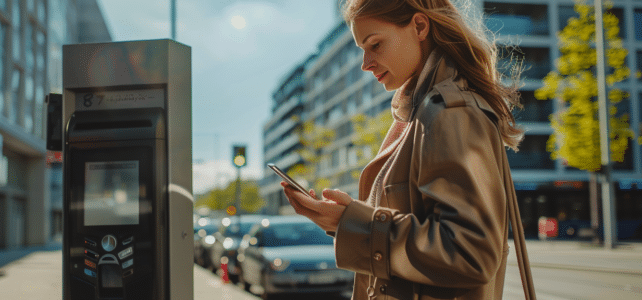
The evolution of payment and parking technologies is redefining the contours of professional mobility. Digital solutions, such as mobile applications for parking payments or contactless toll systems, make travel smoother and less time-consuming. This transformation simplifies the lives of professionals who often need to travel for work, allowing them to manage their time and resources more efficiently. These technological advancements also pave the way for new business models and a smarter, more sustainable approach to urban mobility.
The impact of new technologies on professional mobility
In a society where the revolution in professional mobility is underway, new technologies play a leading role. Mobile digital tools, now ubiquitous, transform the perception of travel time and, consequently, alter our activities while on the move. These advancements are not merely a convenience; they create a true smart mobility, where the management of time and travel becomes more flexible and tailored to individual needs.
Take the example of EMV: NFC terminals in Nice, where contactless payment is disrupting urban parking habits. This technology allows for a significant time savings, thereby reducing the disutility often associated with travel time. Activities while on the move become more engaging, enhancing the perception of time spent in transit.
Researchers Jain and Lyons, by examining the phenomenon of activities while on the move, have highlighted how these activities change the perception of travel time. Smartphones and other mobile devices enable a multitude of tasks that were once confined to the workplace or home. The utility of travel time is thus recognized and valued through digital tools, transforming lost moments into productive or relaxing opportunities.
Social interactions are not left behind, facilitated by mobile phones and smartphones that eliminate barriers of space and time. Sheller and Urry conceptualized this mobility that integrates transport as a key element of modern interactions. Professional mobility is therefore no longer just a transition from point A to point B; it becomes an extension of living and working space, where every minute can be optimized and valued.

The challenges of innovative payment and parking solutions
In the context of shared mobility and the rise of electric vehicles, innovative payment and parking solutions are emerging as strategic levers. These technologies provide answers to the challenges of increasing urbanization and aim to streamline traffic in city centers. Devices such as free-floating or dedicated parking applications change the relationship between public and private space, promoting optimized use of urban infrastructure.
Consider the impact of these innovations in metropolises like New York or San Francisco, where parking management becomes more complex with urban densification. The implementation of agile payment services and adaptive parking solutions offers users a personalized experience and meets the demand for smooth mobility. These advancements also allow for the integration of different modes of transport, from personal vehicles to public transport, including new forms of shared mobility.
Studies by researchers such as Adoue and Crozet show that these innovative solutions have a direct impact on users’ modal choice. By reducing barriers to change, these technologies encourage more sustainable mobility that is less dependent on individual cars. They also influence travel practices, encouraging the use of electric vehicles or promoting carpooling, in line with the increasingly prevalent ecological values in the daily decisions of urban dwellers.