
Determining the ideal weight for a woman is not just about reading a number on a scale. Age, body shape, distribution of body mass, and sex profoundly affect what can be considered a reliable health benchmark. Several formulas coexist, each with its biases, and none provides a definitive answer on its own.
Ideal weight calculation formulas: what each really measures
The Lorentz formula, the Creff formula, and the body mass index (BMI) are the three most cited tools. Their logic differs, and the results they produce for the same person can vary by several kilograms.
| Formula | Variables considered | Main limitation |
|---|---|---|
| Lorentz | Height, sex | Ignores age and body shape |
| Creff | Height, age, body shape (slender, normal, large) | Subjective morphological classification |
| BMI (Quetelet) | Height, body mass | Does not distinguish between fat mass and muscle mass |
The Lorentz formula remains popular because it is simple to apply. It incorporates sex into its coefficient, making it slightly more suitable than a calculation purely based on height. However, it was designed without considering aging or differences in body frame.
The Creff formula partially corrects this flaw. By adding age and a coefficient related to body shape, it produces more realistic ranges for a fifty-year-old woman than for a twenty-five-year-old woman. The problem remains with morphological categorization: classifying oneself as “slender” or “large” introduces a degree of approximation.
BMI divides weight in kilograms by height in meters squared. A doctor uses it as a first-level indicator, but BMI says nothing about body composition. An athlete with high muscle mass can have the same BMI as a sedentary person with more fat mass.
Knowing these differences allows for better interpretation of the ideal weight for a woman as it appears from an online calculation or consultation.

Ideal weight by age: why the reference evolves
Over the years, body composition changes even if the number on the scale remains stable. Muscle mass gradually decreases, while the proportion of fat mass tends to increase. This phenomenon begins well before menopause but accelerates after it.
The same weight can correspond to very different metabolic realities at thirty and sixty years old. This is why the Creff formula incorporates age: it acknowledges that a weight deemed “normal” at twenty-five is not necessarily relevant two decades later.
A doctor takes into account other markers before making a judgment: waist circumference, blood pressure, lipid profile, level of physical activity. The ideal weight is not an isolated number; it is one indicator among others in a comprehensive health assessment.
The effect of menopause on fat distribution
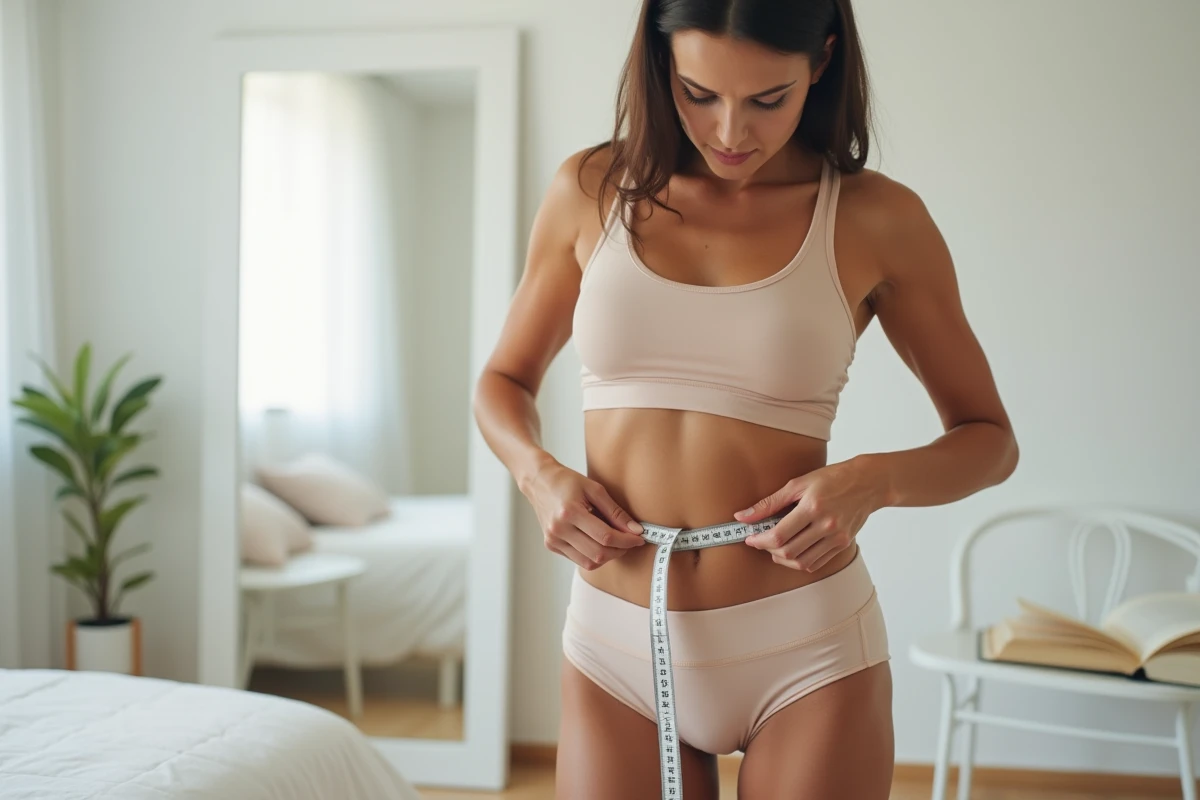
The drop in estrogen promotes abdominal storage rather than on the hips and thighs. This change in distribution increases metabolic risk even without visible weight gain. Waist circumference then becomes a more relevant indicator than weight alone.
Body shape and bone structure: the variables that formulas simplify
Two women of the same height and age can have radically different bone structures. A fine bone structure (narrow wrists, slightly broad shoulders) corresponds to a lower reference weight than a large bone structure.
Classic formulas treat this reality in a binary or ternary way (slender, normal, strong). The body, however, operates on a continuum. Here are the elements that influence weight without being excess fat mass:
- Bone density: it varies according to heredity, diet, and physical activity (walking, running, weight training)
- Muscle mass: a woman who regularly engages in strength sports weighs more at the same height, without it indicating a health problem
- Water retention: fluctuations related to the hormonal cycle can represent more than a kilogram from one day to the next
- Distribution of fat mass: the waist-to-hip ratio provides information that neither BMI nor the Lorentz formula captures
These variables explain why no single formula can replace the opinion of a doctor who knows the patient’s history.
When to consult a doctor rather than calculate alone
Online calculators have an educational interest: they show a reference range. Their limitation appears as soon as it comes to interpreting a deviation. A BMI slightly above the so-called “normal” range does not automatically mean a health risk, and vice versa.
An assessment with a healthcare professional provides three things that no formula offers:
- A measurement of body composition (bioelectrical impedance or skinfolds) that distinguishes fat mass from lean mass
- A cross-reference with family and personal history (diabetes, cardiovascular issues, eating disorders)
- A personalized weight goal that takes into account real lifestyle, not just a mathematical equation
The ideal weight is one where health indicators are favorable, not one dictated by a statistical norm. The number on the scale can remain the same for years while body composition deteriorates, or conversely, improve despite a slight weight gain related to muscle gain.
The Lorentz, Creff formulas, and BMI remain useful tracking tools, provided they are read for what they are: approximations. The most reliable data remains that produced by a comprehensive clinical examination, tailored to the age, body shape, and medical history of each woman.