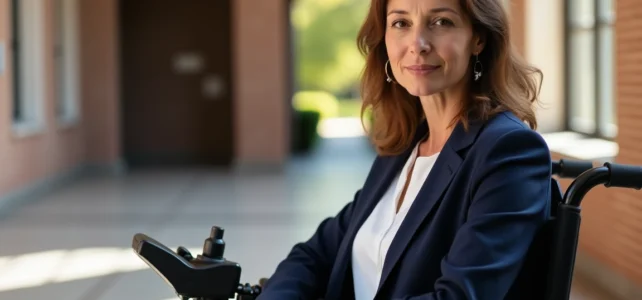
When we look into Stephen Hawking’s private life, one practical detail always comes up: his total dependence on a daily care team. It was in this very concrete context, that of permanent medical assistance at home, that Elaine Mason entered his life in the late 1980s. Their relationship, forged in the constrained intimacy of caregiving, resulted in a marriage, serious accusations, a divorce, and a debate that remains unresolved.
The voice synthesizer, an unexpected thread in the couple’s story
One detail that often gets overlooked is the connection between Elaine Mason and Stephen Hawking long before their marriage: Hawking’s voice synthesizer was designed with the involvement of David Mason, Elaine’s ex-husband. David Mason, a computer engineer, was working on the communication system that would become the most recognizable voice in contemporary science.
Elaine, on the other hand, was a nurse. She joined Hawking’s care team in Cambridge while her own husband contributed to the physicist’s equipment. The daily proximity between caregiver and patient did the rest. For a biographical couple whose sources contradict each other on so many points, this link through the voice synthesizer remains a documented and verified fact.
The marriage was celebrated on September 16, 1995, in Cambridge. One can delve into the biography of Elaine Mason and Stephen Hawking to gauge how much this union surprised the physicist’s entourage, who initially saw it as a professional caregiver-patient relationship.

Abuse allegations: what the police really concluded
Articles and forums discussing the couple often repeat a simplified narrative: Elaine Mason allegedly abused Stephen Hawking. The documented reality is more nuanced and deserves attention.
During the 1990s and 2000s, several police investigations were conducted following reports. Unexplained injuries (burns, wrist fractures, cuts) were reported by members of the care team and relatives. Cambridgeshire police investigated multiple times.
The outcome of these investigations is the point that most online content glosses over:
- No charges were brought against Elaine Mason following the police investigations
- Stephen Hawking himself always denied being a victim of abuse and refused to cooperate with investigators on this matter
- Hawking’s children, despite being in open conflict with Elaine on other issues, publicly confirmed the lack of sufficient evidence to pursue charges
Persistent accusations but no charges filed, that is the situation as documented. Hawking and Mason divorced in 2006, officially citing “irretrievable breakdown of the marriage,” a standard British legal term.
Elaine Mason after the film The Theory of Everything
The film by James Marsh, released in 2014, tells Hawking’s story mainly through the lens of his first wife, Jane Wilde. Elaine Mason appears only as an antagonistic figure, reduced to the role of “the other woman” without depth or context.
This cinematic treatment has had concrete consequences on public perception. In the British press, several journalists and biographers criticized the caricature of the character after 2015. An experienced nurse, Elaine Mason had managed the daily care of a patient with advanced Charcot’s disease, a task whose weight is rarely described in media portrayals.
Analyses published after the film’s release have initiated a more nuanced reevaluation. Described as abrasive by those around her, Elaine Mason also demonstrated real dedication in the daily management of Hawking’s disability. Feedback on this point varies according to the sources consulted, but the post-2015 trend clearly leans towards a less black-and-white interpretation.
Jane Wilde and Elaine Mason: two roles in the face of disability
The comparison between Hawking’s two wives is not just a matter of tabloid press. It raises a very concrete question: what is it like to live alongside a person with total physical autonomy loss for decades?
Jane Wilde married Hawking in 1965, shortly after the diagnosis of Charcot’s disease was made. She accompanied the gradual deterioration of his motor skills, the birth of three children, and his rise to global fame after the publication of A Brief History of Time. Their divorce occurred in 1995, after more than twenty-five years of marriage.
Elaine Mason took over in a different context: Hawking was already completely dependent, communicated exclusively through his synthesizer, and enjoyed worldwide notoriety. Daily life was nothing like that of the early years of the disease. Managing the care of a famous patient surrounded by a medical team involves as much logistical coordination as it does couple dynamics.
Jane Wilde recounted her experience in two autobiographical books. Elaine Mason, however, has never spoken publicly after the divorce. This silence has left room for others’ narratives and partly explains why her image remains so polarized.
The story of this extraordinary couple cannot be reduced to media accusations or the romanticized version presented in film. Between the voice synthesizer designed by her ex-husband, the unresolved police investigations, and the post-divorce silence, Elaine Mason remains a figure whose complete portrait is still missing.